Home · Catalogue · Philosophy & Classics · S.I.6119
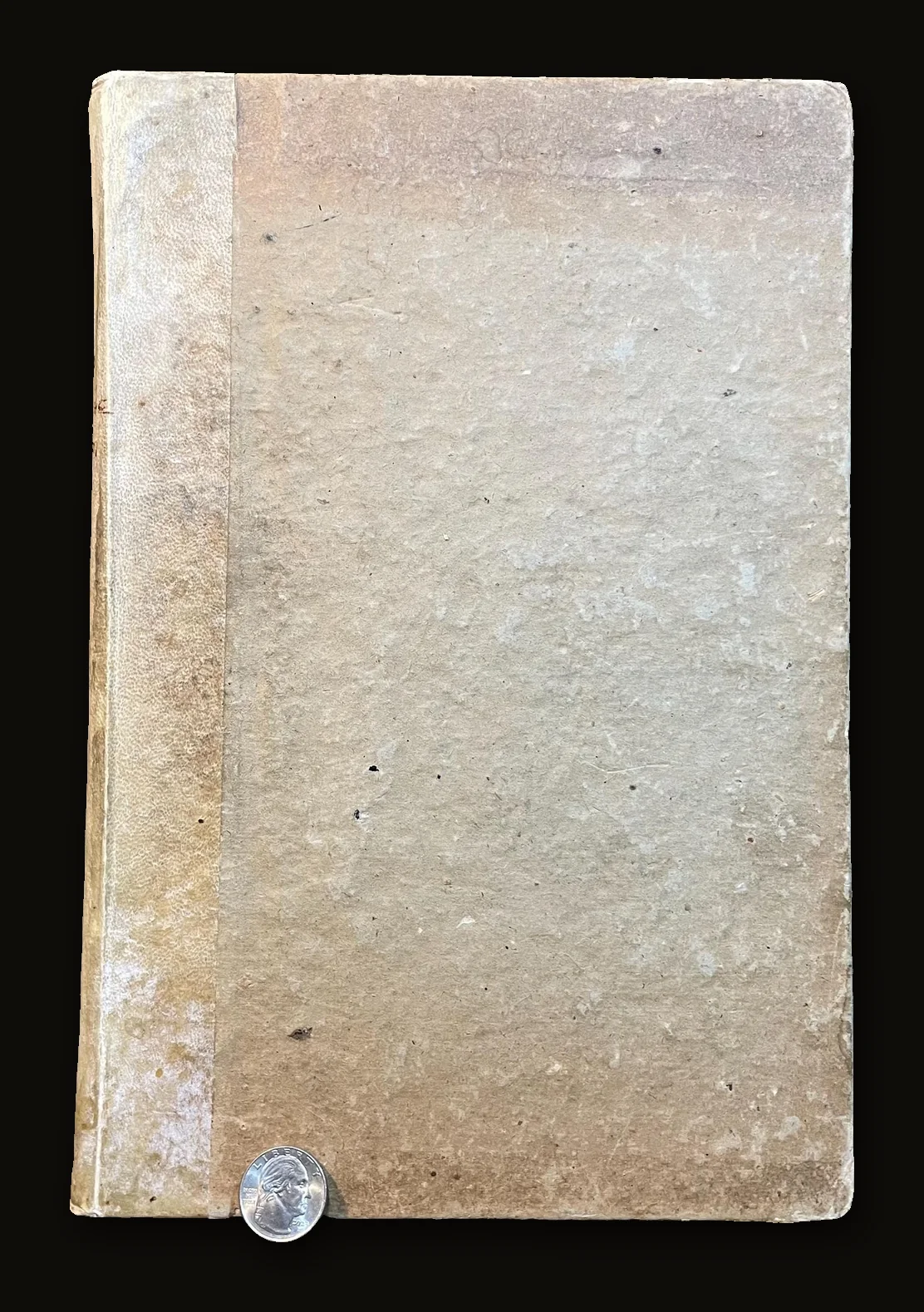
Epistolae ad Brutum, ad Quintum fratem, ad Atticum. Hoc in volumine haec continentur Epistola ad Augustinum Mapheum per Bartholmeum salicetu(m) Bononiensem: & Ludovicu(m) Regiu(m) Coreliensem. Translated from Latin: Letters to Brutus, to Quintus brother, to Atticus. In this volume, the following are contained: a letter to Augustine Mapheus by Bartholomew Salicetus of Bologna, and to Louis Rex of Cora.
Marcus Tulius Cicero and Cornelius Nepos · Venice
- Author
- Marcus Tulius Cicero and Cornelius Nepos
- Date
- 1499
- Place
- Venice
- Publisher
- Phillipus Pincius
- Language
- English
- Binding
- Folio. (8.125" x 12") Quarter vellum over paper boards. Spine with old ink manuscript author/title towards head, gilt year at foot. Edgewear, corners bumped, head of spine with tiny closed tears. Covers soiled, stained. Dampstain to edges of textblock towards rear.
- Format
- tic00503000 Bod-inc Id: C-286 Headings: Cicero, Marcus Tullius Epistolae ad Brutum, et al. Analysis of content: a1r [Title-page.] a1v Salicetus, Bartholomaeus; Regius, Ludovicus: [Letter addressed to] Augustinus Maffeus. Incipit: ‘Ecce studiosis, litterarum cultor Augustine, uolumina epistolarum . . .’ a2r Cicero, Marcus Tullius: Epistolae ad Marcum Brutum. Cic. Ad Brut. 6-7; 9; 11; 13-26 only. b1r Cicero, Marcus Tullius: Epistolae ad Quintum fratrem. Cic. Q. fr. 1; 2. 1-3; 2. 4 with 2. 6. 2-4; 2. 7; 2. 8. 1-2 with 2. 5; 2. 6. 1-2 with 2. 8. 3; 2. 9-16; 3. c8r Cicero, Marcus Tullius [pseudo-]: Epistola ad Octavianum. [Cic.] Oct.. d6r Cicero, Marcus Tullius: Epistolae ad Atticum. Cic. Att. 1-3; 4. 1-9; 4. 11-15; 4. 16. 1-5 with 4. 17. 3-5 with 4. 18; 4. 19. 1 with 4. 16. 6-9; 4. 17. 1-3 with 4. 19. 2; 5-8; 9. 1-8; 9. 8. C; 9. 8. B; 9. 8. A; 9. 9-11; 9. 11. A; 9. 12-13; 9. 13a; 9. 13. A; 9. 14-19; 10-16. 12. 1-16 all one, also 12. 29-53; 13. r1r Cornelius Nepos: Vita Attici. Nep. Att. r3v Laetus, Julius Pomponius: [Verse addressed to] Augustinus Maffeus. Incipit: ‘Quaeque erat altiloqui Ciceronis epistola Bruto | Missa aut ad Quinton(!), Attice siue tibi'; 5 elegiac distichs. r3v Laetus, Julius Pomponius: [Note addressed to the reader.] Incipit: ‘Simplicius scripsi quam rei dignitas requirebat . . .’ r3v Laetus, Julius Pomponius: [Note to the readers.] Incipit: ‘Lector ubi emerseris quid trierarcho impreceris propter salutem non habes. Haueto'.’ r4r Regius, Ludovicus: [Letter addressed to] Augustinus Maffeus. Incipit: ‘[N]on te preterit, unice ac studiosissime Romanarum rerum . . .’ Imprint: Venice: [Philippus Pincius], 12 June 1499. Folio. H 5218 records a date of 15 July. Collation: a–q8 r4. References: Source: Bodleian ISTC: ic00503000 HC *5217; H 5218; Goff C‑503; BMC V 499; GW 6862; Pr 5322; Sheppard 4409. LCN: 14884470
- Category
- Philosophy & Classics
- Record
- S.I.6119
Epistolae ad Brutum, ad Quintum fratem, ad Atticum. Hoc in volumine haec continentur Epistola ad Augustinum Mapheum per Bartholmeum salicetu(m) Bononiensem: & Ludovicu(m) Regiu(m) Coreliensem. Translated from Latin: Letters to Brutus, to Quintus brother, to Atticus. In this volume, the following are contained: a letter to Augustine Mapheus by Bartholomew Salicetus of Bologna, and to Louis Rex of Cora.
Author: Marcus Tullius Cicero; 3 January 106 BC – 7 December 43 BC
Folio. (8.125" x 12") 1499.Marcus Tullius Cicero. Venice. Phillipus Pincius. Quarter vellum over paper boards. Spine with old ink manuscript author/title towards head, gilt year at foot. Edgewear, corners bumped, head of spine with tiny closed tears. Covers soiled, stained. Dampstain to edges of textblock towards rear.
From Wiki: Marcus Tullius Cicero; 3 January 106 BC – 7 December 43 BC was a Roman statesman, lawyer, scholar, philosopher, writer and Academic skeptic, who tried to uphold optimate principles during the political crises that led to the establishment of the Roman Empire. His extensive writings include treatises on rhetoric, philosophy and politics. He is considered one of Rome's greatest orators and prose stylists and the innovator of what became known as "Ciceronian rhetoric". Cicero was educated in Rome and in Greece. He came from a wealthy municipal family of the Roman equestrian order, and served as consul in 63 BC.
He greatly influenced both ancient and modern reception of the Latin language. A substantial percentage of his work has survived, and he was admired by both ancient and modern authors alike. Cicero adapted the arguments of the chief schools of Hellenistic philosophy in Latin and created a large amount of Latin philosophical vocabulary via lexical innovation (e.g. neologisms such as evidentia, generator, humanitas, infinitio, qualitas, quantitas), almost 150 of which were the result of translating Greek philosophical terms.
Epistulae ad Brutum (Letters to Brutus) is a collection of letters between Roman politician and orator Marcus Tullius Cicero and fellow politician, and conspirator against Julius Caesar, Marcus Junius Brutus. The letters in this collection, when combined with Cicero's other letters, are considered some of the most reliable sources of information for the period leading up to the fall of the Roman Republic. Cicero became acquainted with Brutus through his close friend Titus Pomponius Atticus, an admirer of Brutus. Their personal relationship likely grew during their time together in opposition to Caesar during the civil war in 49 BCE, it being firmly established by the time Cicero returned to Rome in the autumn of 47.
Traditionally divided into two books, the collection features 26 letters written from March or April to July 43 BCE — a year after the assassination of Julius Caesar, and a year before the death of Brutus in 42. The authenticity of the letters was for a long time cast into doubt, but is now generally recognized, with the exception of the first book's letters 16 and 17. These two letters resemble the style of suasoriae — exercises in rhetoric commonly used by students of the late Republic and Augustan eras. The second book of Cicero's letters to Brutus was first printed by Andreas Cratander of Basel in 1528 from a now lost manuscript obtained for him by Sichardus from the Abbey of Lorsch.
We are currently putting all 5000+ titles online, but if there is a specific title you are looking for, please reach out to sidekerbookselleratgmail.com, we may just have it!
Free shipping via USPS for United State purchaser within the continental U.S., International shipping determined using USPS Priority Express, DHL, FedEx, or Parcel Monkey.
Sonny Ideker Bookseller is located within City Antiques in Historic Roswell, Georgia at 700 Holcomb Bridge Road, Roswell, GA. 30076. We would love to have you visit or email us at sidekerbookselleratgmail.com for specific wants or needs, thanks!
Find Us On: Facebook: https://www.facebook.com/p/Sonny-Ideker-Bookseller-Rare-Antiquarian-Leather-Vellum-Bound-Books-100068669041560/ YouTube: https://www.youtube.com/@SonnyIdekerBookseller/about Instagram: https://www.instagram.com/sonny_ideker_bookseller Flickr: https://flic.kr/ps/2v6pn4 Website: https://sonnyideker.weebly.com/ Antique Books, Old Leather Book, Old Vellum Book, Decorative Binding, Antiquarian Book, Vintage decorative, Ancient Leather, Rare Books, Decorative Books, Decorative Leather, Beautiful Decorative Book That Rare Book Guy Sonny Ideker City Antiques & Interior Arts Georgia Antiquarian Booksellers Association Colette French Pastries
Condition
Very Good
Guaranteed authentic and as described · 7-day returns · free US shipping — our terms. Subject to prior sale.